Calculation method and official guidance checked October 27, 2026
Pay calculator: hours and minutes
7 hours 30 minutes at an illustrated $20/hour equals $150.00 in straight-time wages: (7 × 60 + 30) ÷ 60 × $20. Enter confirmed paid durations and your agreed rates below. The result is an entered wage subtotal, not a determination of overtime, total wages owed or take-home pay. All rates in the worked examples are synthetic, editable assumptions.
Calculate your entered wage subtotal
The first row is the illustrated example. Clear all fields in a row to leave it unused. In a used row, enter both hours and minutes, including an explicit zero when appropriate. A missing rate stays pending; it is never treated as free work.
$150.00 — illustrated straight-time wage subtotal
450 minutes × 2,000 rate cents ÷ 60 = 15,000 cents. Other payroll adjustments remain to be confirmed.
Use one employee's records. Enter durations, not clock-in times or decimal hours. Keep each actual rate on its own row. The tool adds exact minute × rate-cent numerators, divides their sum by 60, then rounds the final positive subtotal to the nearest cent, with a half-cent rounded up. It does not round punches. This is the calculation method used here, not a claim that every payroll system must use the same rounding convention.
Four ways to check the money against the minutes
| Illustrated inputs | Exact-time calculation | Comparison or boundary |
|---|---|---|
| 7h30m at $20/hour | (7 × 60 + 30) = 450 minutes; 450 ÷ 60 × $20 = $150.00 | Misreading 7:30 as 7.30 hours gives $146.00; difference $4.00. |
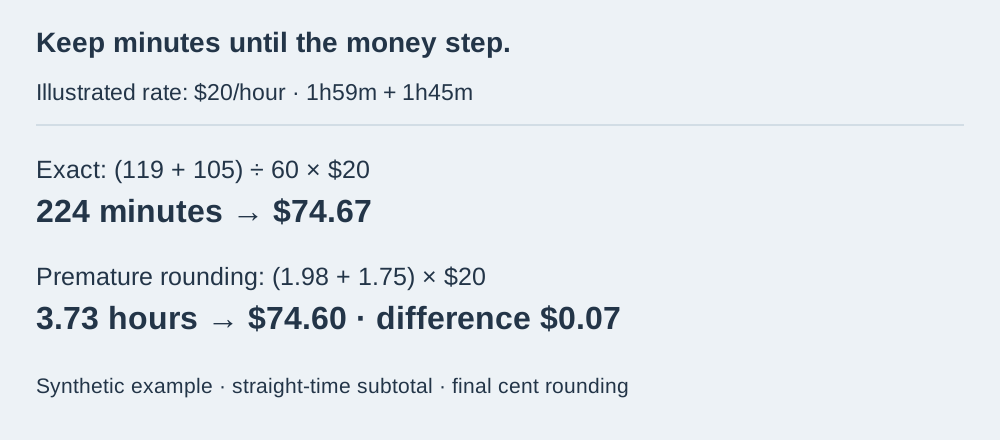
| 1h59m + 1h45m at $20/hour | 119 + 105 = 224 minutes; 224 ÷ 60 × $20 = $74.67 after final cent rounding | (1.98 + 1.75) × $20 = $74.60; difference $0.07. |
| Three entries of 8h01m at $25/hour | 481 × 3 = 1,443 minutes; 1,443 ÷ 60 × $25 = $601.25 | 8.02 × 3 = 24.06 hours; 24.06 × $25 = $601.50; difference $0.25. |
| 7h30m at $20; 2h15m at $24 | 450 ÷ 60 × $20 = $150; 135 ÷ 60 × $24 = $54; subtotal $204 | These are straight-time amounts at entered rates, not an overtime regular-rate calculation. |
Separate a time-format error from a rounding choice
A colon and a decimal point describe different units. In 7:30, the second part is thirty minutes. In 7.30 hours, it is thirty hundredths of an hour: 0.30 × 60 = 18 minutes. The missing 30 − 18 = 12 minutes explains the $4.00 difference at $20/hour: 12 ÷ 60 × $20 = $4.00. This is a unit error before any cent-rounding decision.
The 224-minute example is different. Its durations are valid, but converting each to only two decimal places loses precision before the wage multiplication. Retaining 224 minutes lets the tool carry the fractional cents until the final subtotal. The displayed dollar differences are original sensitivity examples, not evidence that a particular employer or another calculator underpays anyone.
For an audit, retain the underlying minutes, the rate and the rounding method, rather than only a screenshot of decimal hours. A different documented payroll convention can produce a different reconciliation. First reproduce that convention; do not silently adjust the recorded time to make the numbers match.
Multiple rates are not an overtime determination
The $204 example keeps two rates attached to two durations. Using one rate for every entry would erase information. But even a correct straight-time sum does not settle overtime. The federal regular-rate calculation can involve compensation beyond a single quoted hourly rate, and the employee's actual workweek matters. Coverage and exemptions must also be established.
The DOL official overtime general principles · checked October 27, 2026 explains the distinction. This tool does not classify employees, allocate overtime hours, calculate bonuses or premiums, or determine tax withholding. Leave those items open until reviewed; do not label this subtotal as net pay.
Confirm the time before multiplying the rate
A duration entered here should already represent the paid time you intend to reconcile. Do not enter a lunch deduction simply because a timecard has a lunch box. The DOL official meal-and-rest-period overview · checked October 27, 2026 distinguishes rest breaks from bona fide meals, with state requirements considered separately.
If you start from punches, the payroll-hours calculator preserves whole minutes across shifts. For an unresolved meal interval, the lunch timecard calculator keeps paid and excluded scenarios separate. This page begins at the next step: multiplying established paid durations by entered rates. Provider subscription fees are a different bill; use the annual payroll cost calculator for that.
Take the calculation back with its unanswered questions
The CSV exports the current rows, exact minutes, hourly rate in cents, the numerator used before division by 60, the subtotal and its UTC generation date. Blank response cells let you record supporting evidence. If any used row is incomplete or invalid, the full entered subtotal stays pending; an unanswered amount never becomes zero.
- Confirm paid durations against the original time record and meal treatment.
- Confirm agreed hourly rates and when each rate took effect.
- Review the actual workweek, overtime eligibility and regular-rate calculation.
- Resolve bonuses, shift premiums and other compensation separately.
- Apply required taxes and deductions before describing any figure as take-home pay.
- Record the payroll reviewer, date and the rounding convention used.
The exact numerator in the file can be checked independently: for the first example, 450 × 2,000 ÷ 60 = 15,000 cents. The exported rates are your entries, not a verified legal wage rate. The file is a reconciliation worksheet, not a complete payroll or compliance record.
Three questions before using the subtotal
Is 7:30 the same as 7.30 hours?
No. 7:30 is seven hours thirty minutes, or 7.50 decimal hours. Enter hours and minutes in their separate fields so a decimal point cannot change their meaning.
Why can rounded decimal hours change the pay?
Rounding the time before multiplying can discard fractions that affect cents. The worked 224-minute example yields $74.67 at the illustrated rate, while the prematurely rounded 3.73-hour version yields $74.60.
Does this subtotal include overtime or taxes?
No. It sums straight-time amounts at the rates you entered. Overtime, additional compensation, withholding and deductions require separate review before a complete payroll or take-home figure can be stated.