Method and official guidance checked October 26, 2026
Time card calculator with lunch
08:30–17:00 with lunch from 12:00–12:30 gives 8.00 hours if that meal is properly excluded, or 8.50 hours if it is paid. The two work segments are 210 + 270 = 480 minutes; 480 ÷ 60 = 8.00. Including the 30-minute meal gives (210 + 30 + 270) ÷ 60 = 8.50. These are illustrated clock records, assuming no clock change. A meal's name or duration alone does not establish that it may be unpaid.
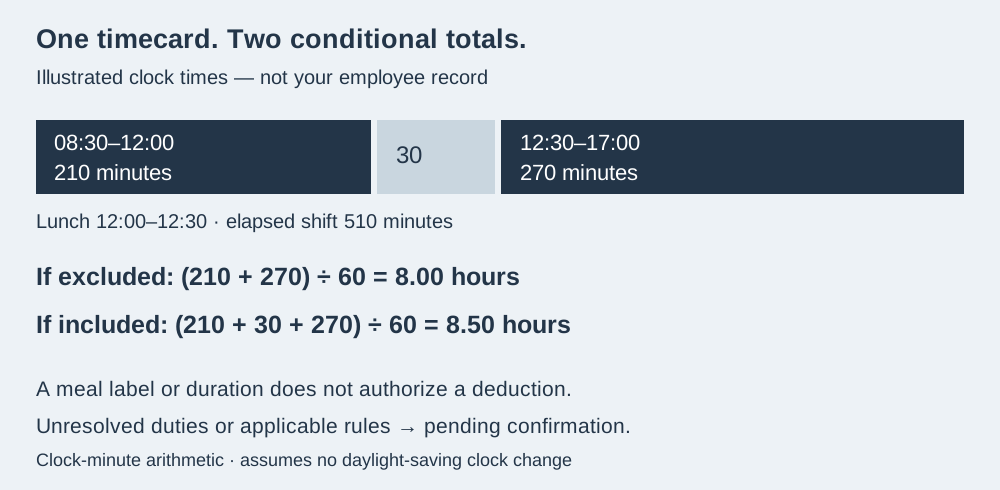
Enter actual lunch-out and lunch-in times
Use one employee's actual shift. The dates make overnight work explicit; no earlier clock time is silently moved to tomorrow. The defaults reproduce the example, with treatment deliberately unresolved. Downloading preserves that uncertainty rather than turning it into zero.
Example scenarios: 8.00 hours if excluded; 8.50 if included. Entered payroll result: Pending confirmation.
Export includes current inputs, both conditional totals, any unresolved result, blank evidence cells and its UTC generation date. Open the CSV in a spreadsheet to fill the confirmation column, or print it. It is not a complete timekeeping or compliance record. No rounding, wage rate, overtime premium or automatic deduction is applied. For several shifts, calculate each separately and keep integer minutes before summing; the weekly payroll-hours calculator totals already-confirmed unpaid minutes across days.
Same interval, different treatment
| Illustrated facts | Time arithmetic | What remains to establish |
|---|---|---|
| Meal is confirmed excludable | 210 + 270 = 480 minutes; 8.00 hours | Retain duty-relief and applicable-rule evidence. |
| Employee works through lunch or must perform duties | 210 + 30 + 270 = 510 minutes; 8.50 hours | Review the work record and any separate state meal obligations. |
| Only a 30-minute automatic deduction is recorded | Both 480 and 510 minutes remain scenarios | No confirmed payroll total until the actual facts are checked. |
The difference is 510 − 480 = 30 minutes, or 30 ÷ 60 = 0.50 hour per illustrated shift. Across five identical shifts that is 30 × 5 = 150 minutes, or 2.50 hours. This is a sensitivity calculation, not an assumed violation or an estimate of wages owed. If the meal contained work, do not simply certify a blanket deduction because the software offered one.
Two questions: must a meal be provided, and may this time be excluded?
Those questions need separate answers. Federal guidance does not generally require meal or rest breaks under the FLSA. Short rest breaks generally count as work; bona fide meals generally do not. State obligations may add requirements. DOL official meal-and-rest-period overview · checked October 26, 2026.
For duty relief, the federal advisor asks whether the employee is completely relieved throughout the meal. Required active or inactive duties matter, including answering calls or watching equipment. It says leaving the premises is not necessary under that federal test; a state rule can be more protective. DOL official meal-period duty-relief test · checked October 26, 2026. This page does not approve a shorter-meal exception.
| Limited state scope | Official guidance to check | Keep separate from arithmetic |
|---|---|---|
| California | Generally a meal of at least 30 minutes when work exceeds five hours; a limited mutual waiver may apply when the total day does not exceed six hours. Longer days and industry exceptions need additional review. | Duty relief, timing and any valid exception are separate checks. California guidance also addresses paid on-duty meals and required presence on the premises. |
| New York | The state's meal-period guidance varies with the work schedule and industry. Use its official requirements for the actual shift. | Do not apply California's timing or a generic lunch deduction to a New York record. |
| Other states | Not assessed here. | Obtain applicable official guidance; leave the review pending. |
California DLSE official meal-period FAQ · checked October 26, 2026. New York DOL official day-of-rest and meal-period guidance · checked October 26, 2026. These summaries are not a fifty-state determination. Paying time and meeting a state's meal-provision obligation are not interchangeable.
Items to confirm before using the payroll total
- Actual shift dates and all worked segments, including work before or after recorded punches.
- Actual lunch-out and lunch-in times; distinguish a real record from a preset deduction.
- Whether the employee was fully relieved, with any interruptions or required duties documented.
- The work state, applicable industry and employee rules, and any valid exception or waiver.
- Meal timing and length, plus any second-meal issue for a longer shift.
- Contract and policy promises about paid meals or breaks.
- Clock-change accuracy, payroll review and the evidence retained with the time record.
Unanswered facts remain pending in the export. The unpaid option produces a user-confirmed arithmetic result only after the required review fields are completed; it is not a legal certification. If work or duties are reported during lunch, the tool includes the whole interval as paid rather than subtracting the selected meal. Any unusual case needs an appropriate payroll or legal review.
Three questions before deducting lunch
Can I automatically subtract thirty minutes for lunch?
No. A preset duration does not show what actually happened or whether the time may be excluded. Confirm the actual interval, duties and applicable requirements first; unresolved facts stay pending.
Does a required meal period automatically mean an unpaid meal?
No. A requirement to provide a meal and the treatment of its time are separate questions. Check both the governing meal rule and whether this particular interval is compensable.
Can I calculate an overnight lunch timecard?
Yes, by entering the actual next date for lunch or shift end. This calculator uses clock minutes without time-zone or daylight-saving adjustment; independently correct a clock-change record before relying on its total.
All displayed example totals are original arithmetic from the stated clock records. For provider fees rather than employee hours, use the annual payroll quote calculator.