Official sources checked October 31, 2026 · USD
Rippling payroll pricing: reconcile the quote, not just the headcount
Rippling's complete payroll price requires a custom quote. Its small-business page advertises a starting reference of $40 per month plus $8 per user: five illustrative users give $80 monthly or $960 over twelve months, from ($40 + $8 × 5) × 12. That reference is not a confirmed payroll package, a price guarantee or your bill. Payroll modules, contract quantities and one-time charges remain pending until matched to a written proposal.
What the official pages establish
The Rippling official small-business starting-price reference · checked October 31, 2026 supplies the $8 user rate and $40 monthly base. Its product scope and your selected package still need matching. The Rippling official pricing and payroll quote FAQ · checked October 31, 2026 directs payroll buyers to obtain custom pricing based on their workforce and selected services.
Do not add a review site's payroll estimate to that public reference and call the result official. A price from somebody else's negotiated proposal is not yours. We have not obtained a customer-specific Rippling quote or verified a historical rate series. This page therefore leaves payroll's separate rate, setup, credits and renewal terms unresolved.
| Line in your proposal | Evidence needed | How it enters the annual bill |
|---|---|---|
| Platform or package base | Exact package, currency, billing period and any included products | Add the quoted base for every applicable period, once |
| Each selected module | Its own rate, billing unit, included quantity and required dependencies | Rate × that module's billable quantity, period by period |
| Committed quantity or minimum | Written floor, reset date and whether reductions are allowed | Apply the actual written rule; do not assume current staff equals licensed seats |
| Setup and credits | Implementation scope, amount and credit timing | Add confirmed one-time cash; subtract only documented applicable credits |
A headcount decline can leave the same rate on a larger denominator
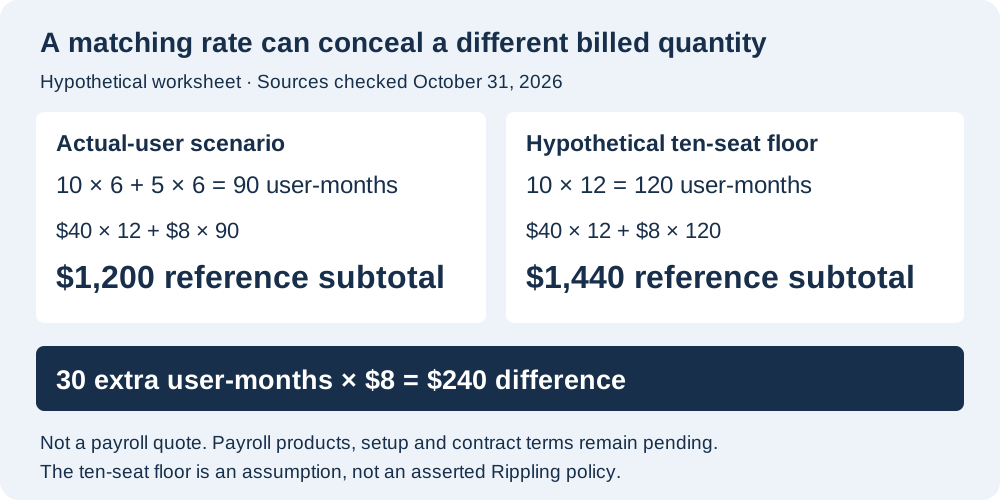
Consider an illustrative twelve-month schedule: ten users for six months, then five for six. These headcounts and durations are scenario inputs, not a customer account. Actual-user billing produces 10 × 6 + 5 × 6 = 90 user-months. A hypothetical agreement with a ten-seat floor for the full year produces 10 × 12 = 120 user-months.
The difference is 120 − 90 = 30 user-months. At an unchanged rate R dollars per user-month, that quantity difference costs 30 × R. You can calculate the exposure from a written rate without inventing a payroll price. Whether your agreement actually contains a floor is a question to confirm, not a conclusion supplied by this example.
| Reference-only calculation | Actual-user scenario | Hypothetical ten-seat floor |
|---|---|---|
| First six months | 6 × ($40 + $8 × 10) = $720 | 6 × ($40 + $8 × 10) = $720 |
| Final six months | 6 × ($40 + $8 × 5) = $480 | 6 × ($40 + $8 × 10) = $720 |
| Annual reference subtotal | $720 + $480 = $1,200 | $720 + $720 = $1,440 |
The difference is $1,440 − $1,200 = $240, also 30 × $8. Each of the last six months differs by five seats × $8 = $40; 6 × $40 = $240. This isolates the quantity effect under the published starting reference. It is not a full payroll quote, a claim about contract cancellation or a claim that Rippling imposes this floor.
Keep unknown payroll rates symbolic until the quote arrives
If a written proposal separately charges p dollars per payroll user-month, uses the same scenario quantities for that module, and otherwise matches the reference base and user rate, the two expressions become:
- Actual-user scenario: $1,200 + 90 × p + S − C.
- Hypothetical floor scenario: $1,440 + 120 × p + S − C.
- Difference, with identical setup and credits: $240 + 30 × p.
S is confirmed setup cash and C is a confirmed applicable credit. Neither has a default of zero. There is no complete dollar total until these inputs and the quoted rates are known. If the quoted person rate already includes the platform, do not add $8 again. Replace the entire reference expression with the actual package formula.
Modules may have different billing units and quantities. A payroll license, a time user and a managed device are not interchangeable rows. The general equation is: annual provider cash = sum of period bases + sum of each module's rate × its applicable quantity for each period + confirmed one-time charges − confirmed credits. A written fixed minimum amount or changing price requires its own line, not an assumed seat floor.
Reconcile the invoice in both directions
- From the roster to the quote: list actual users and each product they use. Keep personal employee information out of public worksheets.
- From the quote to the invoice: record the contracted billing definition and quantity separately. Identify any difference from the roster.
- Ask what changes immediately, at renewal or only after notice when headcount falls.
- Record product scope, setup, support, credits and renewal dates before comparing a total.
- Keep wages, employer taxes and benefit funding outside the software subtotal. Keep your internal transition work outside the provider invoice.
Download the fillable Rippling quote reconciliation (CSV)
The file carries the dated reference calculations, the symbolic payroll adjustment and blank monthly/module rows. Actual headcount, contracted quantity, price, evidence and confirmation status remain separate columns. It is an editable ledger, not an automatically calculating workbook or a verified Rippling contract.
Once scope and quantities are confirmed, transfer the appropriate recurring amounts into the annual payroll quote calculator. If the other proposal includes accounting, the Gusto–QuickBooks component comparison shows why that separate product must be identified first. It does not establish a like-for-like Rippling package or a ranking.
Three questions before accepting a payroll quote
Is Rippling payroll $8 per employee?
The $8 figure is a published starting reference; it does not establish a complete payroll price. The official payroll pricing FAQ directs buyers to a custom quote.
Does reducing staff automatically reduce the bill?
That depends on the written billing and commitment rules in your agreement. Ask for the billable quantity, reduction mechanism and effective date; do not infer them from the phrase per employee.
Why can identical person rates produce different annual costs?
The billable quantities can differ even when the rates match. Our hypothetical 90-versus-120 user-month example differs by 30 × R; at the $8 reference alone that is $240, with payroll-specific charges still pending.