Official sources checked November 1, 2026 · USD
Patriot software pricing: count three different billing quantities
The illustrated Full Service Payroll schedule below costs $891 at regular rates: $37 × 12 + $5 × 45 + $6 × 12 + $2 × 27 + $12 × 8 = $891. It has forty-five paid-worker months, twenty-seven time-card-user months and eight additional-state months. Treating every quantity as five workers and three filing states all year would give $1,224, a $333 difference. These are our editable examples, not a customer invoice, promotional quote or complete employer budget.
Start with the published payroll rate
The Patriot official payroll pricing and billing FAQ · checked November 1, 2026 lists Basic at $17 monthly plus $4 per worker paid, and Full Service at $37 plus $5 per worker paid. The same page says the payroll base remains due in a month with no payroll, and lists the optional Time & Attendance and HR products at $6 monthly plus $2 per employee, each.
| Regular-price scope | Five paid workers for a month | Twelve identical months |
|---|---|---|
| Basic Payroll | $17 + $4 × 5 = $37 | $37 × 12 = $444 |
| Full Service Payroll | $37 + $5 × 5 = $62 | $62 × 12 = $744 |
| Difference between these subscriptions | $62 − $37 = $25 | $744 − $444 = $300 |
Basic leaves tax filing and deposits to you; Full Service adds that service. The $300 difference is not your internal filing cost, tax liability or guaranteed saving. Wages, employer taxes, benefit funding and any separately quoted services are outside these software subtotals.
A paid worker is not necessarily a time-card user
For payroll, count each distinct worker paid during each billing month, not the number of pay runs. For the time product, the Patriot official Time & Attendance usage FAQ · checked November 1, 2026 says the employee charge follows time-card usage in the billing period. Do not automatically copy payroll headcount into that field. A person paid a salary may not use a time card; a time-card record and its payroll payment may also fall in different periods.
For filing states, the Patriot official multi-state filing rate and scope · checked November 1, 2026 includes the first filing state with Full Service and prices each additional state at $12 monthly. Count additional billed filing states, not all work locations. Confirm when an added state starts and stops being billed; an employee leaving a state does not establish the end of filing obligations or fees.
Reproduce the $891 schedule
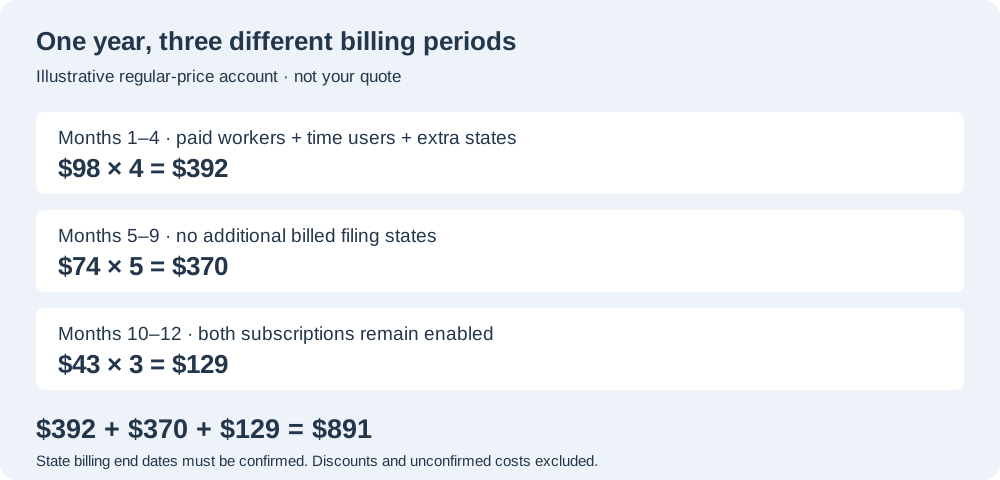
Assume the Full Service subscription and Time & Attendance remain enabled for twelve regular-price months. In the first nine months, five distinct workers are paid monthly and three employees use time cards; the last three months have no paid workers and no time-card users. Separately assume a written billing schedule confirms two additional filing states are charged for only the first four months. This last condition is deliberately supplied, not inferred from payroll activity.
| Illustrative period | Payroll per month | Time product per month | Extra filing states per month | Period subtotal |
|---|---|---|---|---|
| Months 1–4 | $37 + $5 × 5 = $62 | $6 + $2 × 3 = $12 | $12 × 2 = $24 | ($62 + $12 + $24) × 4 = $392 |
| Months 5–9 | $62 | $12 | $12 × 0 = $0 | ($62 + $12) × 5 = $370 |
| Months 10–12 | $37 + $5 × 0 = $37 | $6 + $2 × 0 = $6 | $0 | ($37 + $6) × 3 = $129 |
| Annual software subtotal | $392 + $370 + $129 | $891 | ||
The aggregate proof is paid-worker months = 5 × 9 + 0 × 3 = 45; time-card-user months = 3 × 9 + 0 × 3 = 27; additional-state months = 2 × 4 = 8. The two base subscriptions contribute $37 × 12 = $444 and $6 × 12 = $72. Variable charges contribute $5 × 45 = $225, $2 × 27 = $54 and $12 × 8 = $96. Therefore $444 + $72 + $225 + $54 + $96 = $891.
Contrast a flat-count assumption: ($37 + $5 × 5 + $6 + $2 × 5 + $12 × 2) × 12 = $102 × 12 = $1,224. Its excess is $75 for fifteen extra paid-worker months, $66 for thirty-three extra time-card-user months, and $192 for sixteen extra-state months: $75 + $66 + $192 = $333. This is a reconciliation of different inputs, not a claim that a provider billed incorrectly.
If the additional states are actually billable throughout the year, use twenty-four additional-state months instead of eight. That adds $12 × (24 − 8) = $192 and raises this example to $1,083. If the state schedule is unknown, the complete subtotal is pending rather than $891.
Download the worked monthly ledger & fillable checklist (CSV)
Calculate your confirmed annual quantities
This tool covers twelve regular-price months of Full Service Payroll. Add the distinct billed counts period by period before entering them. Time & Attendance months must be the months you subscribe to that product; its user-month quantity follows actual billable time-card usage. Additional-state months exclude the included first state. Leave an unknown quantity blank. Explicit zero means you have confirmed none applies.
Illustrative regular-price software subtotal, not your quote.
Keep promotions and other charges separate
The pricing page advertises a thirty-day trial followed by fifty percent off for three months. For five paid workers, the displayed discounted Full Service rates give $18.50 + $2.50 × 5 = $31 monthly. If those terms apply to each of three paid billing months, twelve paid months with constant headcount give $31 × 3 + $62 × 9 = $651. This is not the first 365 days after signup: trial days and billing dates must be reconciled separately. Eligibility, add-on discounts and state-fee treatment need confirmation. The $891 worked account and tool use regular prices only.
Do not append a standard setup or year-end filing fee to Full Service when the relevant scope is included. Basic customers considering electronic contractor filing should instead check the Patriot official 1099 e-filing scope and fee schedule · checked November 1, 2026; that page distinguishes Basic and Accounting from Full Service. Amendments, late work, state registration, accounting and benefit-provider charges still need their own scope and evidence. We have not verified a historical price series or obtained a customer quote.
Items to confirm before signing
- Exact plan and whether tax filing, standard setup and year-end work are included.
- Distinct workers actually billed in every period, including contractor payments.
- Time-product subscription months and billable time-card users, recorded separately.
- Additional filing states, written billing start/end dates and continuing filing obligations.
- Offer eligibility and which charges are discounted; map trial days to actual invoice dates.
- Any exceptional work, third-party charges, applicable sales tax and your internal transition cost.
To bring these quantities back into a broader quote review, use the homepage annual-cost calculator for the provider cash charges and your own transition work. Before borrowing a competing package's annual figure, use the Gusto versus QuickBooks scope worksheet to separate included filing and selected extras. A low base fee is not a matched service scope.
Questions about Patriot payroll pricing
How much is Patriot Full Service for five paid workers?
At regular rates it is $62 monthly, or $744 for twelve identical months before selected extras. The calculation is ($37 + $5 × 5) × 12. The $891 example adds an explicitly different time-card and state-billing schedule; it is not a universal five-person price.
Does a month with no payroll make the whole bill zero?
No: the payroll base remains due. In our regular-price example, zero paid workers still leaves the $37 payroll base and the $6 time-product base because that optional subscription is assumed to stay enabled. Confirm separately whether state filing fees or other products remain billable.
Should time-card users always equal paid workers?
No: reconcile the two counts independently. Payroll uses distinct workers paid in the month; the official time-product FAQ uses employees with time-card usage in the billing period. Count each unit once in the appropriate period, then retain the underlying invoices and usage records.