Official prices and offer terms checked October 30, 2026 · USD
Homebase payroll pricing: the annual bill behind the offer
At the standard rate, five paid employees cost $79 monthly or $948 for twelve months of payroll: ($49 + $6 × 5) × 12 = $948. A qualifying small-team offer can produce a $354 payroll subtotal over twelve months beginning with the first payroll run: six free months + six × ($29 + $6 × 5). These are different price paths. Both exclude any separately selected Homebase plan, optional services, applicable tax and wage funding.
Three units to copy separately: plan, payroll, people
The Homebase official plan and payroll rate table · checked October 30, 2026 separates a location-based management plan from payroll. Standard payroll is $49 monthly plus $6 per employee paid. Payroll can be added to Basic; Basic is free only for one location with up to ten team members. A paid management plan is a separate choice or requirement, not an automatic payroll fee.
| Illustrative standard-rate scope | Monthly calculation | Twelve-month subtotal |
|---|---|---|
| Payroll, five paid employees | $49 + $6 × 5 = $79 | $79 × 12 = $948 |
| Payroll, six paid employees | $49 + $6 × 6 = $85 | $85 × 12 = $1,020 |
| Five paid employees + one monthly-billed Plus location | $79 + $70 = $149 | $149 × 12 = $1,788 |
The last row deliberately uses monthly billing for Plus, not its lower annually billed equivalent. It is not the promotional first-year calculation. Do not replace a cash payment schedule with a monthly equivalent without recording the billing commitment. Keep extra locations and separate employer accounts pending until their invoice scope is confirmed.
The $29 offer is a base fee, not the whole monthly bill
The Homebase official small-team payroll offer conditions · checked October 30, 2026 specify $29 plus $6 per paid employee after six free months. Initial team eligibility includes the owner; later reduced-base eligibility is checked when billed. More than five paid employees triggers standard pricing. Setup must finish by December 15, 2026, with the first run between September 15, 2026 and January 20, 2027.
Those are eligibility conditions, not assumptions we can confirm for you. The free interval starts with the first payroll run and covers up to fifty employees paid. Our examples stay below that ceiling and assume qualification. They do not promise approval, future renewal rates or compatibility with another offer.
| Period from first payroll run | Five throughout | Sixth paid employee begins in month nine |
|---|---|---|
| Months one–six | $0 payroll under the qualifying offer | $0 payroll under the qualifying offer |
| Months seven–eight | 2 × ($29 + $6 × 5) = $118 | 2 × ($29 + $6 × 5) = $118 |
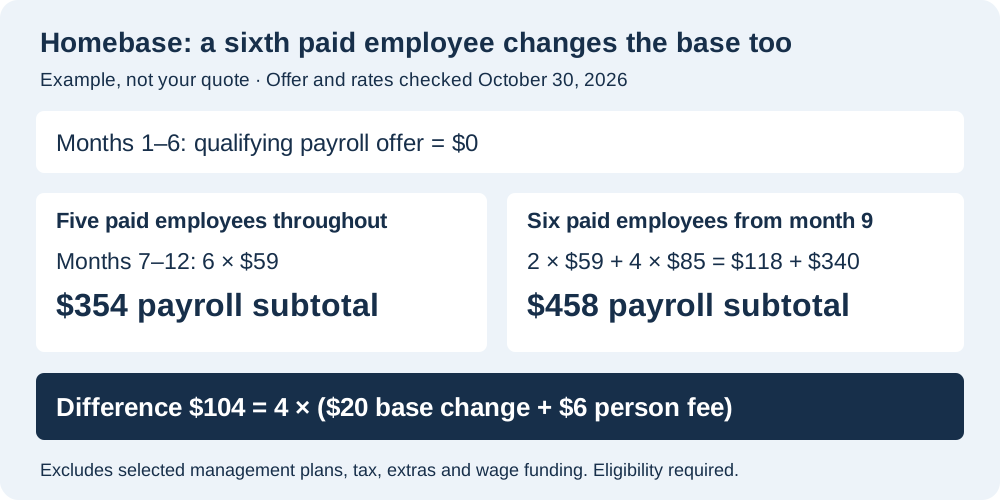
| Months nine–twelve | 4 × $59 = $236 | 4 × ($49 + $6 × 6) = $340 |
| Payroll subtotal | $118 + $236 = $354 | $118 + $340 = $458 |
The difference is $458 − $354 = $104. It decomposes into four months × [($49 − $29) + $6] = 4 × $26 = $104. Only $24 is the extra employee's four monthly person fees; $80 is the lost base-fee reduction. Treating that hire as just $6 more each month understates this scenario by $80.
Reading the offer card as $29 total would instead produce 6 × $29 = $174. For five paid people, that misses 6 × $6 × 5 = $180: $174 + $180 = $354. These calculations concern vendor charges only, not the employee's wages or employment taxes.
Plus and payroll have separate free-period clocks
The Homebase official six-month Plus and payroll terms · checked October 30, 2026 start Plus's free interval at checkout and payroll's at the first payroll run. This is a separate offer path. We have not assumed it combines with the small-team reduced base.
Use two start dates in your forecast. In an illustrative twelve-full-period window from checkout, assume the first payroll run is two billing periods later, five employees are paid, the location keeps monthly-billed Plus, and both free intervals apply. Plus is paid for the final six periods: 6 × $70 = $420. Payroll is paid for the final four: 4 × $79 = $316. The combined subscription subtotal is $736, from $420 + $316.
That is different from pretending both clocks start at checkout: 6 × ($70 + $79) = $894. The $894 − $736 = $158 difference is two × $79 payroll periods. This is a full-period sensitivity model, not a prediction of prorated invoices. Confirm actual checkout, run, renewal and billing dates before using it. Do not move a payroll date merely to reproduce the example.
Event fees need quantities, not an invented annual allowance
The Homebase official payroll event-fee schedule · checked October 30, 2026 lists amendment and failed-quarterly-refile charges at $200 per filing, funding failures at $125 per event, post-cancellation filings at $200 each, and print/mail tax forms at $3 per filing. Confirm which service applies before adding it.
For example, three chargeable amended filings would be 3 × $200 = $600, not one $200 charge for an entire multi-quarter correction. This is an event scenario, not an expected annual fee. If no event is known, keep the quantity pending rather than add $600 to every reader's subscription. Record routine filing inclusion separately from exceptional corrections or delivery.
Take the offer ledger back to the provider
Download the fillable Homebase offer ledger (CSV)
The editable CSV records the example calculations, separate offer clocks, paid employee counts, selected location plan and event-fee quantities. Its blank monthly rows are for your actual invoice dates. It is a worksheet, not an automatic spreadsheet model or verified customer bill.
- Confirm the offer identifier and eligibility, including how the owner is counted.
- Record checkout and first payroll dates independently.
- Write the base fee and paid employee count beside each billing period.
- Keep the selected location plan and its monthly/annual commitment on another line.
- Request written treatment of growth, exceptional filings, form delivery and renewal. Leave taxes and unknown charges pending.
The annual quote calculator can hold your verified normal monthly rate; preserve these changing periods in the ledger rather than force them into one constant month. If the alternative quote bundles accounting, the Gusto–QuickBooks cost-component comparison helps separate that product from payroll. It does not establish an equivalent Homebase feature package.
Three Homebase pricing questions
Does Homebase payroll require a paid scheduling plan?
No: the official pricing page allows the payroll add-on on Basic, subject to Basic's one-location and team-size limits. Selected paid features or a larger operation can change the management-plan bill.
Does $29 cover five employees after the free period?
No: the small-team terms make it a $29 base plus $6 per employee paid, so five paid employees cost $59 in a qualifying billed month. Eligibility and dates must still be confirmed.
What happens when a qualifying team pays a sixth employee?
After the free period, standard pricing applies when more than five employees are paid at billing, according to the offer terms. In our month-nine growth example the annual payroll subtotal rises from $354 to $458; the increase includes both the base-fee change and the extra person fee.